
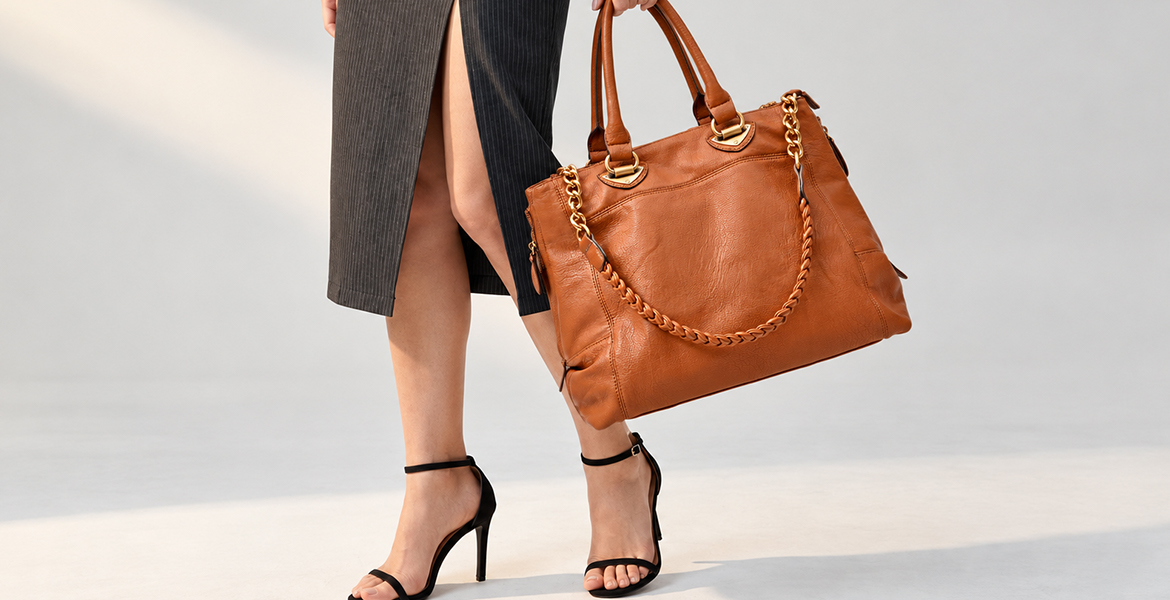
Even after passing all the visual tests, a handbag can still become irritating the moment real life begins. Imagine you’re carrying a drink, holding an umbrella, checking a message, opening a door, or balancing shopping bags when suddenly you need your wallet. Can you open your handbag, find what you need, and close it again using one hand?
With this simple challenge, you’ll understand about everyday convenience. An ideally arranged product photograph will not be able to reveal such details. This is referred to as the one-hand test. It’s not merely about performing handbag gymnastics, rather it’s a practical way of evaluating closures, pockets, straps, structure, accessibility, and organization, before you can decide whether a handbag truly fits your routine or not.
What Exactly Is the One-Hand Test?
The idea here is pretty straightforward. You need to imagine or physically test whether you can perform common handbag tasks or not, while using only one hand. The following things are tested:
- Can you open the bag?
- Can you reach your phone?
- Can you retrieve your keys?
- Can you access a cardholder?
- Can you close the bag again?
During everyday situations, you have only one hand free in a majority of them. You might be holding groceries, carrying a coat, pushing a door, or managing any other item with another hand. A handbag that constantly requires two-handed attention doesn’t cease to be beautiful. However, if you understand this limitation before jumping into a purchase, you’ll be able to decide whether it suits your habits better or not.
The focus of the test is on convenience and not appearance.
1. Begin With the Main Closure
Start with the obvious interaction of all. Opening your handbag. Different levels of resistance and accessibility is created by different closure systems. Zippers, magnetic fastenings, turn locks, drawstrings, buckles, snaps, and flaps all behave differently.
You must try opening the main compartment with one hand. If the bag features a smooth zipper with an accessible pull, it’s pretty straightforward to open. A stiff zipper might need one hand to stabilize the bag while the other pulls the zipper. Similar kind of difficulty is created by a complicated buckle.
However, this doesn’t make either design automatically unsuitable. Rather you must think about frequency. Even a small inconvenience can become surprisingly noticeable, if you’re opening your handbag 20 times a day.
2. Can the Bag Stay Still?
Until the entire handbag moves with the closure, it may work appropriately. Structure is the key here. When you’re pulling a zipper with one hand, you must notice whether the bag remains stable or twist toward you. Moreover, notice whether the body retains its shape to provide resistance when you’re trying to open a clasp.
Stabilization is sometimes necessary in the case of many soft handbags, as their flexible material moves with the closure. More structured designs may be easier to operate independently.
However, structure alone does not determine convenience. Placement, hardware, strap position, and closure design all contribute. The one-hand test evaluates the entire interaction rather than one isolated feature.
3. Test Your Phone Access
Your phone is probably among the items you retrieve more frequently, making it useful for testing handbag accessibility. Imagine receiving a call while your other hand is occupied. Where is your phone? If it lives inside the main compartment beneath several other belongings, retrieval may become unnecessarily complicated. A dedicated slip pocket, exterior compartment, or easily accessible interior section can reduce searching.
Check pocket dimensions whenever they are provided. A pocket is only useful when the object you intend to store there actually fits. Also consider whether the pocket closes safely enough for your preferences while remaining easy to access.
4. Give Your Keys Somewhere Sensible
Keys possess an impressive ability to migrate toward the least convenient corner of any handbag. The one-hand test exposes this problem quickly. If your keys share one large compartment with everything else, finding them without looking may require some determined rummaging. Internal pockets, small compartments, clips, or dedicated sections can help establish a predictable location.
The important point is consistency. If you always know where your keys are, you are less dependent on seeing inside the bag. That becomes particularly useful when your hands are occupied or lighting is poor. Good organization reduces unnecessary searching.
5. Pay Attention to Strap Stability
Convenience is not only about what happens inside the handbag. The strap itself affects how easily you can access the bag while carrying it. A shoulder bag that constantly slides down your arm can turn a simple search for your wallet into a balancing exercise. A crossbody strap may provide greater stability because the bag remains connected across the body.
Handle-only bags behave differently again. Think about whether you must place the handbag on a surface before opening it or whether you can comfortably access it while carrying it. Also consider strap width, adjustability, placement, and attachment points. A stable bag is usually easier to operate with one hand.
6. Look at the Opening Width
Capacity tells you how much a handbag can contain. Opening width tells you how easily you can reach that capacity. A bag may have a spacious interior but a surprisingly narrow opening. Try reaching inside with one hand without fully rearranging the bag.
Can your hand move comfortably? Can you see enough of the interior to identify objects? Does a rigid edge restrict movement? Flaps can also influence access. Some remain open naturally, while others repeatedly fall back into place. These details may seem minor during shopping, but repeated interactions magnify them. Convenience lives in small movements.
7. Consider Interior Visibility
The one-hand test becomes significantly harder when you cannot identify what you are reaching for. Interior visibility depends on several factors, including opening size, lining color, compartment arrangement, and bag depth. Deep bags can hide smaller objects at the bottom. Dark interiors may make similarly dark belongings harder to distinguish visually.
Organization can compensate. Separate pockets for frequently used items reduce the need to inspect the entire interior whenever you need something. Think of your handbag as a tiny storage system. The easier its layout is to understand without looking into it, the more naturally it can fit into everyday routines.
8. Try the Payment Test
Imagine standing at a counter with something already in one hand. Can you retrieve your wallet or cardholder with the other? This combines several elements of the one-hand test at once: closure operation, bag stability, opening width, organization, and pocket placement.
Then reverse the process. Can you return the wallet and close the handbag without putting everything else down? A bag may be easy to open but surprisingly awkward to close. Certain flaps require alignment, drawstrings may need adjustment, and some clasps require precise positioning. Convenience includes finishing the interaction, not merely starting it.
9. Think About Your Chaotic Day
Do not evaluate a handbag only for calm situations. Picture your busiest realistic day. Perhaps you are carrying additional bags, wearing multiple layers, commuting, moving between locations, or frequently reaching for small belongings. Would the handbag cooperate?
This mental exercise is useful when shopping online because physical testing may not be possible. Study photographs showing the interior, straps, closures, pockets, and bag opening. Read measurements cautiously. Look for enough information to understand how each feature operates. Then imagine using those features while one hand is unavailable. Practical imagination can reveal limitations that styled photographs cannot.
10. Decide How Much Convenience You Actually Need
Not every handbag must pass every part of the one-hand test. An occasional evening bag may prioritize compact proportions or an unusual closure over rapid access. A bag used daily may benefit far more from effortless operation. The intended purpose matters.
Rather than declaring a design practical or impractical, ask whether its level of convenience suits the situations where you expect to carry it. This creates a more useful standard. A handbag does not need to perform every possible task. It simply needs to perform the tasks that matter to you without creating unnecessary friction.
Make Your Handbag Work With You
The one-hand test changes the question from “Does this handbag look good?” to “How does this handbag behave?” That shift can reveal plenty.
Closures determine access. Structure affects stability. Pockets reduce searching. Straps influence positioning. Opening width controls movement. Interior organization determines whether frequently used items are immediately available or buried beneath everything else.
Before buying your next handbag, imagine your other hand occupied. Open the bag. Find your phone. Retrieve your keys. Reach for your wallet. Put everything back. Close the bag. If those simple actions feel unnecessarily complicated before the handbag has even entered your wardrobe, everyday use probably will not make them easier. A convenient handbag should carry more than your belongings. It should carry its share of the work.