
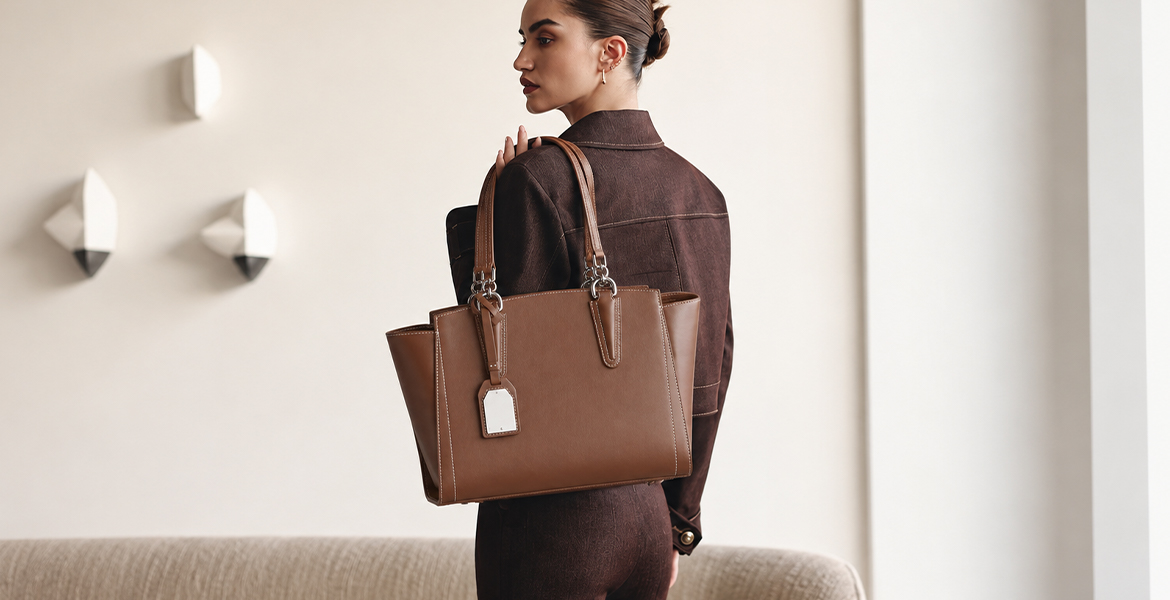
A handbag that looks irresistible on a product page may appear strangely impractical three days after it arrives. That sleek little shape suddenly cannot hold your sunglasses. Your key disappears as the spacious tote turns into a bottomless cave. Rather than completing your outfit, the dramatic shoulder bag spends more time sliding down your arm.
It’s rare that the the real problem of a handbag is its bad looks. More often, the handbag fails to match the way you actually dress, carry, commute, organize, and move. Run your choice through these ten questions before clicking checkout. With just a few minutes of scrutiny, you can easily separate a bag that you repeatedly reach out for with the one that quietly retires at the back of your wardrobe.
1. What Will I Actually Carry in It?
Before appearance, start with the contents. Closely think about what travels with you daily. Everything you carry, including phone, wallet, keys, sunglasses, cosmetics, charger, notebooks, water bottles, umbrella, or any other daily essential requires space.
Now compare this list with the dimensions of the handbag that you want to purchase. Judging scale becomes surprisingly difficult with product photography. A structured mini bag can appear larger than it actually is when photographed alone, whereas, a roomy tote can appear compact against the model.
Look into the listed width, height, and depth. Next, compare those measurements with a handbag you already own. Your goal is not to purchase the largest option available. Rather, you must be looking to choose one with enough space for your realistic carrying habits, without paying for unused bulk.
2. Where Am I Going to Carry It?
With a clear role, a beautiful handbag quickly becomes a wardrobe decoration merely. Ask yourself where you expect to use the handbag. More capacity and accessible compartments are essential for daily commuters. A smaller silhouette is better for dinner plans. Hands-free crossbody style is appealing in the case of shopping trips. While workday handbags require space for documents, devices, or additional personal items.
Don’t imagine a lifestyle that you don’t have, imagine an ordinary week. In case you attend formal events rarely, purchasing another tiny evening bag because it photographs beautifully is not correct. It doesn’t add to the versatility of your wardrobe even a bit. When the purpose of a handbag aligns with your calendar, it truly earns its space.
3. Does the Strap Work for Me?
Straps generally don’t receive the kind of attention that they actually deserve. You must check whether a handbag includes a handle, a shoulder strap, an adjustable crossbody strap, or multiple carrying options. Then you must have a look at the strap-drop measurements in case they’re available.
Depending on your body proportions, clothing, and the way you prefer to carry your bags, even a strap that appears comfortably long in a photograph may sit completely differently. Besides, consider seasonal outfits as well. A shoulder strap that sits appropriately on a thin shirt may turn to be restrictive in the case of a thick jacket.
Styling possibilities are expanded with adjustable and removable straps. However, it’s length range must work appropriately for you!
4. Will the Bag Still Feel Comfortable When Full?
An empty handbag tends to be wonderfully deceptive. The weight changes dramatically once you put in stuff like a wallet, phone, cosmetics, charger, bottle, keys, and everything else you carry on a daily basis.
Looking at the bag’s starting wight and the construction is a must here. Heavy hardware, thick materials, decorative chains, and rigid structures tends to add a noticeable amount of weight even before you put anything inside.
Also, think about the number of hours you typically carry your handbag. While a heavier design may feel manageable during short outings, carrying it throughout the day can be a real headache. Your shoulder will experience the purchase differently in comparison to your eyes.
5. Can I Find My Things Without Excavating?
One must remember that capacity and organization are two different things. While a large interior definitely sounds useful, everything tumbling into one compartment can ruin that experience. You don’t want finding your keys to become an archaeological project at all!
Have a look at the internal layout and get answers to the following questions. Are there zipped pockets? Slip compartments? Dividers? Exterior pockets? Separate spaces for smaller essentials?
The organization style that you prefer matters here. While some people enjoy an open compartment, others may want designated pockets. Choosing the layout that complements your habits. You should not expect to transform your habits to match your handbag style.
6. Does the Closure Match How I Use Bags?
Both accessibility and everyday convenience are affected by the closure that your handbag has. A more enclosed interior is provided by zippers, whereas, with magnetic closures you can expect quick access. Flaps help in creating a distinctive silhouette, but can also add an extra movement whenever you reach inside. Immediate access is offered by totes that are open above, but they expose more of your interior.
There can’t be a universally correct closure. You must pick one considering your own routine. Do you constantly reach for your phone, cards, or keys? Then stay away from a complicated fastening system, which can cause irritation. Or if you’re frequently traveling through crowded environments, an open design tends to be less suitable for your preferences.
After repeated use, small functional details tend to become surprisingly more important.
7. Does It Work With My Existing Wardrobe?
Picture your own clothes and forget the outfit that has been displayed in the product photograph you’re seeing. Ask yourself about the trousers, dresses, jackets, shoes, and everyday colors that you would pair with this handbag. Are there several combinations that you can imagine immediately? A striking color, even though can be wonderfully expressive, it should still make sense in your wardrobe, especially if frequent use is your main objective.
Neutral isn’t just indicating that the handbag will automatically be versatile. Purchasing a neutral handbag that has a highly specific shape, texture, or hardware usage, might still result in a clash with your usual styling.
So quit asking, “Do I like this handbag?” and ask, “Do I like this handbag with my clothes?” With this single adjustment, you can easily expose many of your impulse purchases.
8. Am I Buying the Bag or the Trend?
Exciting shapes, textures, proportions, and styling ideas are introduced by trends. They have the power of making something feel urgently desirable, simply because you keep different variations of the same thing.
So, the optimal route here is to ask yourself whether you’ll still want the handbag without the repetition or not. Have a close look at all the elements that are attracting you. What is it? Shape, color, unusual handle, oversized hardware, or tiny proportions?
Do these features actually reflect your personal style? While there’s nothing wrong in choosing something completely trend-driven, it’s better to understand the compatibility of the item with your personal style. Whether you actually enjoy the design or are simply responding to its current visibility makes a huge difference.
9. Have I Read the Product Details Properly?
The photograph is simply there to attract attention. However, what you’re actually ordering can be understood through the product specifications. Read them attentively. You must be checking aspects like dimensions, materials, lining, closure type, compartments, strap details, hardware, included accessories, and maintenance instructions where provided.
Examine multiple angles by zooming into the product photographs. Look at it from the bottom, sides, handles, interiors, closures, and attachment points as well. Does your handbag contains patterned materials or naturally varying textures? Then the appearance may differ slightly between individual pieces.
Another important area is to review the applicable delivery, return and exchange information, before you purchase the item. You must know the process beforehand to avoid any kind of surprises later on.
10. Would I Still Want It Tomorrow?
The simplest question on the checklist so far, and probably the useful one too! Leave the handbag in your cart, close the tab, make lunch, finish your work, sleep on it, then return later. Does the handbag still makes sense after the initial excitement fades? Then you must evaluate it against the practical criteria. Ask the following questions:
- Does it fit your essentials?
- Does it suit your wardrobe?
- Is the size appropriate?
- Does the carrying style work for you?
- Can you identify situations where you will actually use it?
Friction benefits you more than rushing a purchase. With a short delay, you can differentiate between lasting interest and temporary excitement.
Make the Cart Earn the Checkout
Handbag regret often begins when appearance becomes the only selection criterion. A useful purchase sits at the intersection of style and function. It should accommodate what you carry, suit where you go, coordinate with what you wear, and feel manageable throughout the situations in which you expect to use it.
That does not mean every handbag needs to be relentlessly practical. Fashion can be playful, expressive, dramatic, unusual, and wonderfully unnecessary sometimes. The point is simply to know what you are choosing. Before checkout, revisit the ten questions. Check the measurements. Inspect the compartments. Consider the strap. Think about weight. Review the closure. Open your wardrobe. Picture your actual week.